The 361 Energy Fair is back in Barnstaple on September 29th. The 2024 event starts at 10 AM in the Pannier Market with an introduction by Ian Roome, the newly elected Liberal Democrat MP for North Devon.
To give you a better idea of what to expect, here’s a video with extracts from previous 361 energy fairs:
For the first time this year’s fair includes a series of talks on a variety of topics. Our very own Jim Hunt will be giving a presentation on the topic of “An introduction to V2x, making greater use of EV batteries”, and the emphasis will be on vehicle-to-home and vehicle-to-building rather than fully fledged vehicle-to-grid.
I was fortunate enough to find myself on stage for two different panel sessions at the Everything Electric NORTH show in Harrogate last weekend. We recorded those two sessions in full for posterity, but there were plenty of other interesting topics apart from V2x. Some extracts from those can also be found below.
My first panel on Saturday was on the topic of “Vehicle to Everything? What’s the true potential?”, held in the EEN “Giga Theatre”. The tagline for the session was “We believe that V2X could be the biggest benefit of all in a world with battery electric vehicles, but how do we go ‘bidirectional’?”:
As you can see from the video below, I found myself sat next to Robert Llewellyn of Fully Charged fame as a last minute replacement for host Dan Caesar:
Mark Potter from 3ti explained the full suite of V2x three letter acronyms (TLAs for short).
In a press release this morning the Department for Transport of His Majesty’s Government announced that:
New measures to support electric vehicle drivers from the government’s Plan for Drivers have launched today, including grants for schools, cash for councils and new proposals to boost chargepoint numbers.
Technology and Decarbonisation Minister, Anthony Browne, will launch support for greener schools in Nottinghamshire today, with a new grant providing up to 75% of the cost to buy and install chargepoints, up to £2,500 per socket, up from the previous £350.
Paid for by the Department for Transport, the grant forms part of the Workplace Charging Scheme and is available for state-funded schools, colleges, nurseries and academies to boost the chargepoint facilities for staff and visitors. This could also help schools to generate revenue by making their chargepoints available to the public.
The press release is in Dutch, so I’m relying on Google Translate somewhat for this article! There is no explicit mention of V2x technology, but let’s read between the lines:
Hyundai and mobility provider We Drive Solar announced on April 13th a strategic partnership to provide housing projects with the energy system of the future.
I don’t know about you, but I’m getting a hint of vehicle-to-building already. Moving on:
Hyundai is well on its way to becoming a top 3 manufacturer of zero-emission vehicles worldwide, with a specific focus on 100% electric propulsion. By 2040, Hyundai aims to have its global car line-up fully electrified, aiming for a market share of 8 to 10 percent of the global EV market.
In addition to a leading role in electric driving, Hyundai also wants to accelerate the transition to sustainable mobility and optimally unburden customers with the help of innovative services, fully in line with the brand’s Progress for Humanity philosophy. In that context, Hyundai is expanding its e-mobility activities in the Netherlands significantly this year. Hyundai recently announced its partnership with Jedlix, the market leader in smart charging. Starting today, Hyundai is adding a new chapter in accelerating sustainable mobility by announcing its partnership with We Drive Solar.
Smart charging, sometimes referred to as V1G, is part of the equation but what about smart discharging? The press release continues:
Today we are finally able to bring you exciting news of a large vehicle-to-grid installation in the Netherlands, with some unusual twists apart from the sheer number of charging stations.
In a thankfully English language article in PlaceTech it was reported earlier this week that:
Edge has delivered an office building for Triodos Bank in the Netherlands engineered to be sustainable inside and out with the latest circular construction principles designed throughout. The 135,000 sq ft office in Driebergen-Zeist, Netherlands was built with the intention to harmonise with the surrounding fauna and flora, on a construction level and beyond.
Please bear in mind that the article is referring to EDGE Technologies which is part of Dutch developer OVG Real Estate, and not the U2 guitarist!
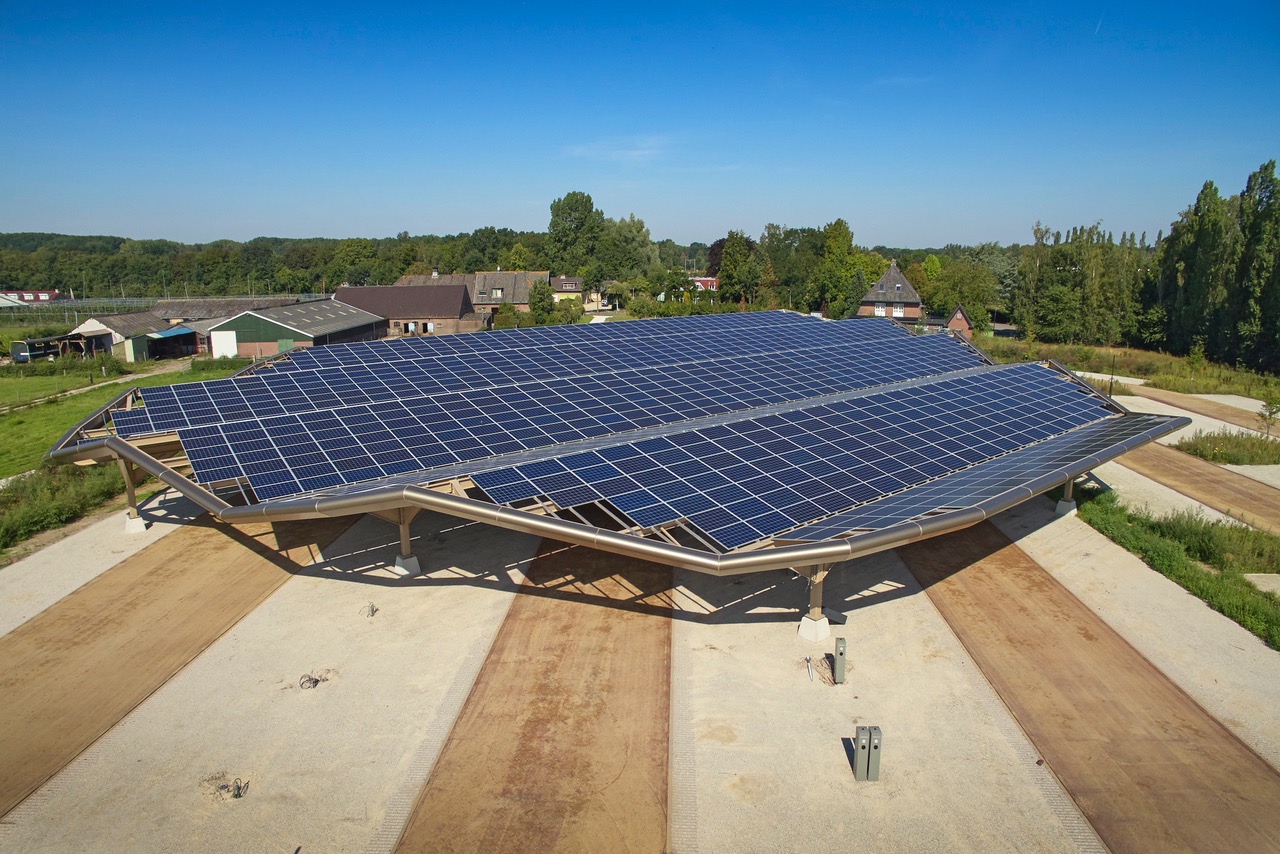
After further description of the office building itself the article eventually gets to the part of the project of most interest to us. The solar PV covered car park:
The extensive use of renewable energy, reflected in over 3,000 m² of solar panels, as well as heat and cold storage, contributes to the energy neutrality of the building. The project encompasses ‘smart charging’ electric cars from solar energy and ‘Vehicle2grid’ technology. Vehicle2grid means that the cars cannot only be charged with solar energy but also discharged, which is called bi-directional charging. The cars become an active part of a ‘smart net’, which includes such benefits as being able to store solar energy.
The PlaceTech article doesn’t go into any more detail than that but we certainly intend to, not least because the aerial view of the solar PV canopy reveals a number of electric vehicle charging stations that look identical to the one we have installed in our “wall to wall” V2G “living lab”:
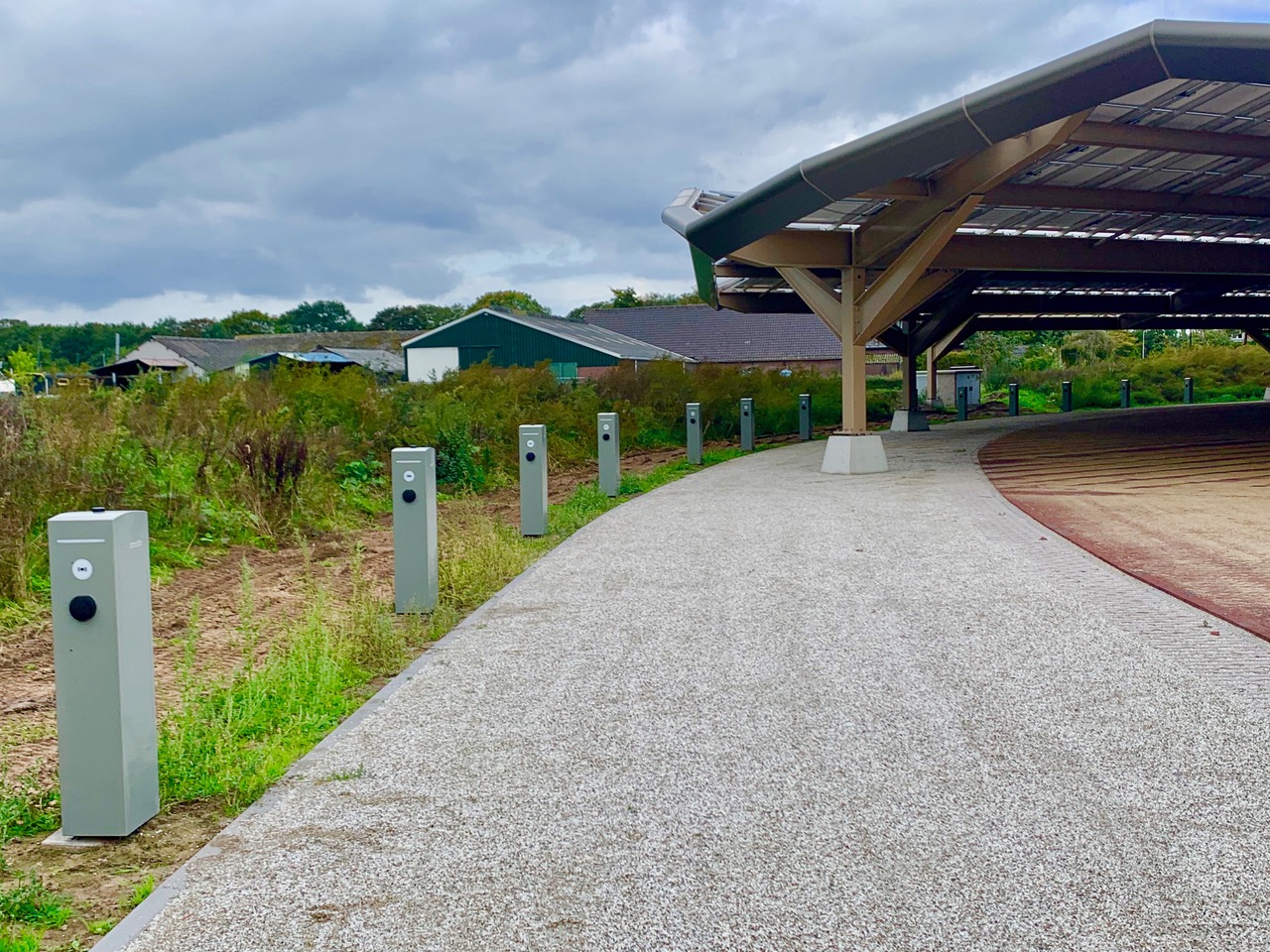
Taking a look at the new Triodos car park from ground level it becomes apparent that a large array of AC V2G capable charging stations are currently being installed, both under and around the solar PV canopy:
To find out more about what’s going on we’ve had to resort to Google Translate. According to a Dutch language article on the Triodos Bank web site from earlier this year:
The largest bidirectional charging plaza in the world is under construction at the new office building of Triodos Bank next to Driebergen-Zeist station. From this Autumn, 120 smart chargers will be able to store solar energy in the batteries of shared electric cars.
Triodos Bank have realised the project in close collaboration with developer EDGE Technologies and We Drive Solar. The bidirectional chargers are directly connected to 3,253 m² of solar panels and have a triple function. Electric cars can charge here. Cars whose battery is full enough can also supply power, so that the energy can be used in the office building or be fed back into the electricity grid.
Part of the plan is that Triodos Bank will replace its pool cars with 100% electric cars, so that they become part of the bidirectional charging ecosystem. Triodos Bank will investigate how, in addition to Triodos Bank employees, the residents of Zeist and the surrounding area can also use its shared electric cars. According to Triodos Bank director Matthijs Bierman “The plan fits in with our new ambitions in the field of sustainable mobility. We want to make car sharing as sustainable and attractive as possible. Not only for our employees, but also for the local community.”
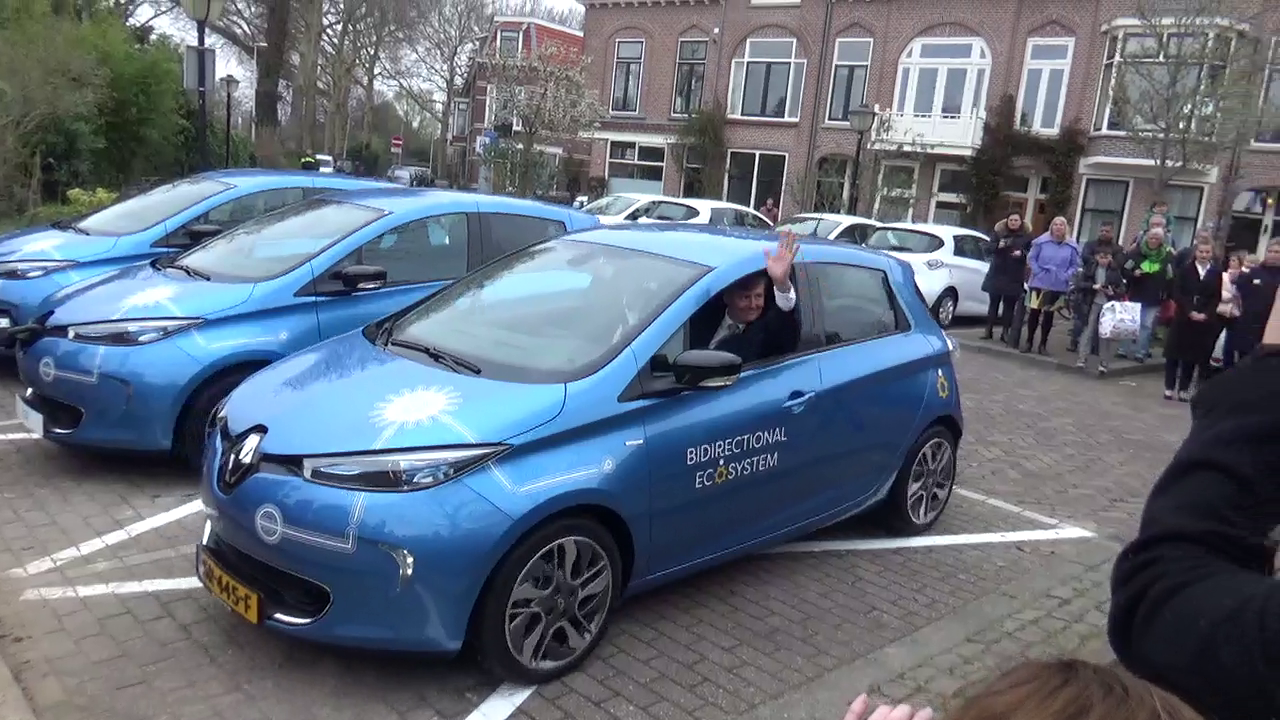
Now 120 AC V2G charging stations sounds amazing, but where are 120 or more AC V2G capable electric cars going to come from? I can help answer that question, since I attended the launch of the We Drive Solar bi-directional ecosystem in Utrecht earlier this year. According to Renault:
A fleet of fifteen Zoe vehicles with vehicle-to-grid charging will be introduced in Europe over the course of 2019 to develop our future offerings in reversible charging and lay the groundwork for the future standards —with our partners’ help. These pilot schemes will begin today in Utrecht (the Netherlands) in an ecosystem developed by We Drive Solar and on Porto Santo Island (in the archipelago of Madeira, Portugal) with Empresa de Electricidade da Madeira, an energy supplier. Following these, more pilot schemes will be introduced in France, Germany, Switzerland, Sweden and Denmark.
So that explains 15 prototype AC V2G capable Renault ZOE’s across Europe in 2019, but that’s a lot less than 120 in the Triodos car park! As far as I am aware Renault have not announced when V2G enabled ZOEs will go into production, but when ultimately they do Triodos Bank will be ready! In the meantime I’m sure that plenty of “smart charging” will be going on in Driebergen-Zeist and across the Netherlands
All in all the project sounds a lot like a combination of our “Camelford Electric Car Club” and “Static and Mobile Distributed Energy Storage” projects, albeit on a much grander scale! That probably explains this remark by Robin Berg of We Drive Solar to Bobby Llewellyn at the recent Fully Charged LIVE event at Silverstone in the summer?
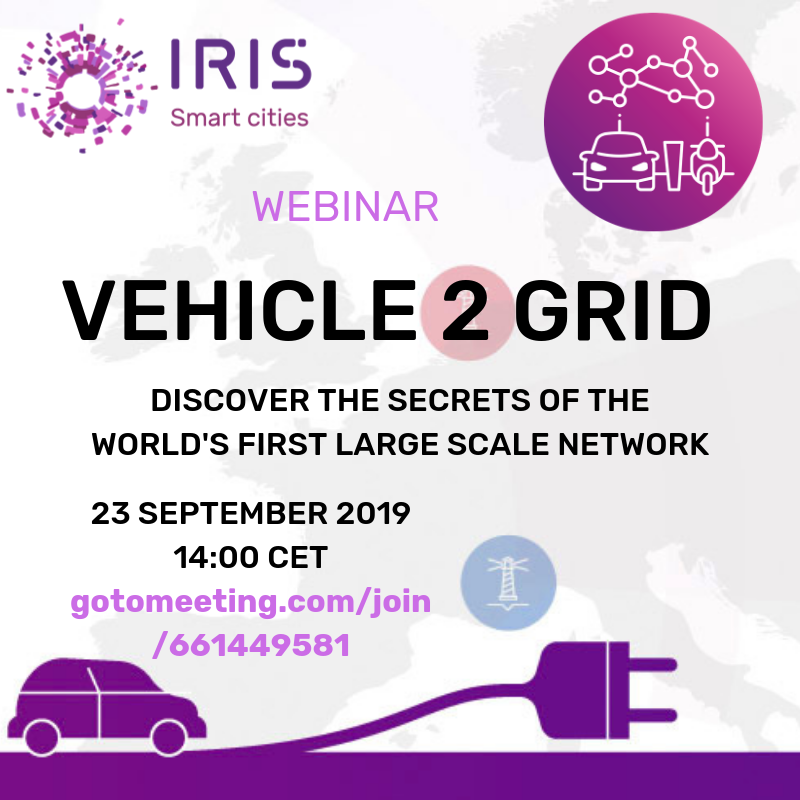
If you want to discover more about the We Drive Solar bi-directional ecosystem then please feel free to attend this webinar on September 23rd at 13:00 British Summer Time:
The following is based on Google’s translation of a Nissan press release currently only available in the original Japanese. Please forgive any inadvertent errors or omissions on my part!
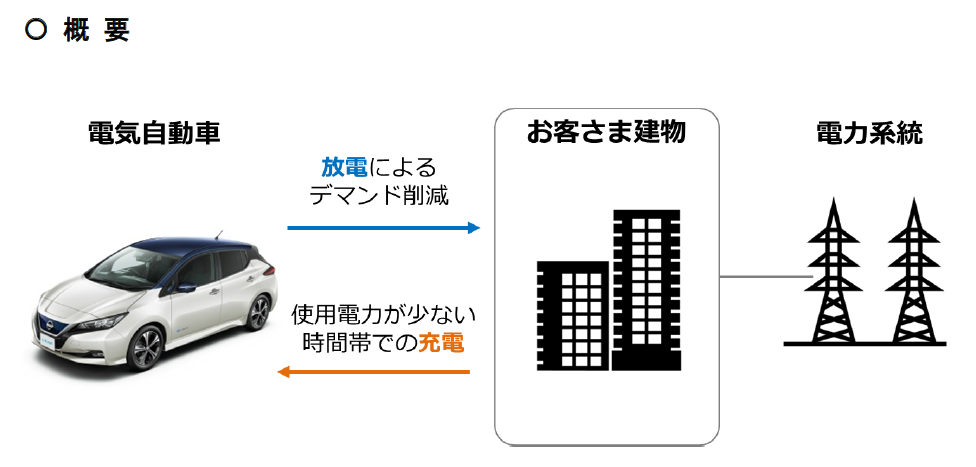
Kyushu Electric Power Company Ltd., ELEX Corporation and Nissan Motor Company Ltd. have announced a pilot V2B project for corporate customers:
In January 2019 we will jointly start a V2B (Vehicle-to-Building) pilot project to reduce maximum power demand:
In this project, we will provide a Nissan LEAF and bi-directional charging station to corporate customers in order to verify the effects of reducing customer’s demand by utilizing the electricity stored in electric vehicles batteries, and also use by the customer as an emergency power source.
Through this project, each company aims to acquire knowledge regarding the creation of new services utilizing EVs, and we will also consider future commercialization.
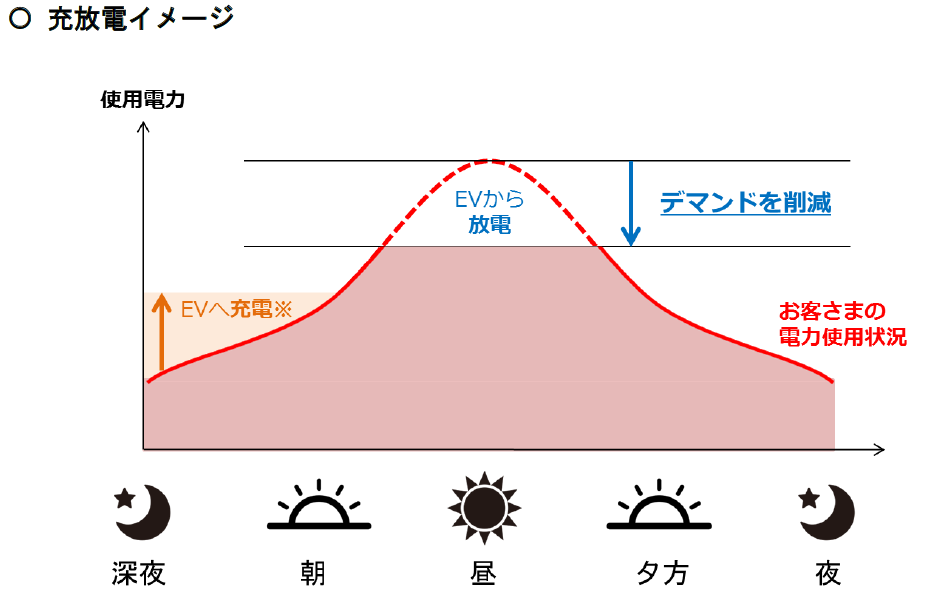
It looks as though peak shaving is the name of the game:
Please watch this space for any further English language news about the project.
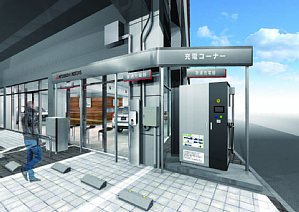
MMC already has 28 showrooms throughout Japan which have solar panels and the ability to use an electric vehicle’s battery power as an emergency power source, via a Vehicle-to-Building (V2B) charger. However the new Omiya “Hyper Energy Station”, opened this week in Saitama City, has also been fitted with its own lithium-ion battery packs to provide substantial power back up to the local electricity grid.
Saitama City has partially subsidized the cost of the facilities and the dealership has been designated a Next-generation Automobile & Smart Energy Special Zone by the Japanese government. The Omiya showroom, run by the Kanto Mitsubishi Motors Sales Group, is the fourth private facility and the first automobile dealer to adopt the system.
Featuring lithium-ion batteries with a capacity of 12kWh, the building can supply power for recharging electric vehicles (EV) in the event of a natural disaster or power outage, when normal power supplies are cut off. EVs have played a key role in transporting people and good in previous emergencies in Japan, when conventional fuel supplies have been severely disrupted.
Here’s an artist’s impression of the combined “Static and Mobile Distributed Energy Storage” (SaMDES for short) unit:
Apart from the new hardware that combines both static and mobile lithium ion battery storage Mitsubishi also pointed out that:
MMC has already opened 28 “DENDO Drive Station” showrooms across Japan, all featuring solar panels and V2B charging stations. It plans to increase this number to 200 by 2020.
In addition to charging vehicles, V2B allows the EV’s battery to provide power to the building in times of high demand or an emergency. The building will then switch to charging the car at times of low grid demand, or when renewable energy production is at a peak. This has major benefits for the grid and provides cheaper, sustainable power for the EV owner.
Hitachi Europe Ltd., Mitsubishi Motors and ENGIE have demonstrated a pioneering project to explore the potential for electric vehicles to act as a means of energy storage for an office building. For this demonstration, the consortium linked the first vehicle to everything (V2X) charger to ENGIE’s office building in Zaandam.
Hitachi’s innovative V2X Charger is the first recharger that cannot only recharge an electric car but can also discharge the energy back into the building/grid providing different flexibilities including kW, ΔkW, kWh and VAR. Moreover, it is possible to connect solar panels and external storage directly to the recharger, allowing a much more efficient electricity supply to buildings.
That all sounds as though Hitachi’s “innovative V2X Charger” is just the thing we need for our V2G “Living Lab” here in sunny South West England. Our “artist’s impression” of the concept is displayed above. As you can easily see it involves most of the buzz words from the press release, including V2H, V2G, Solar PV and “external storage”. It’s also 5 years old, which means we’ve done a lot of research into the necessary technology!
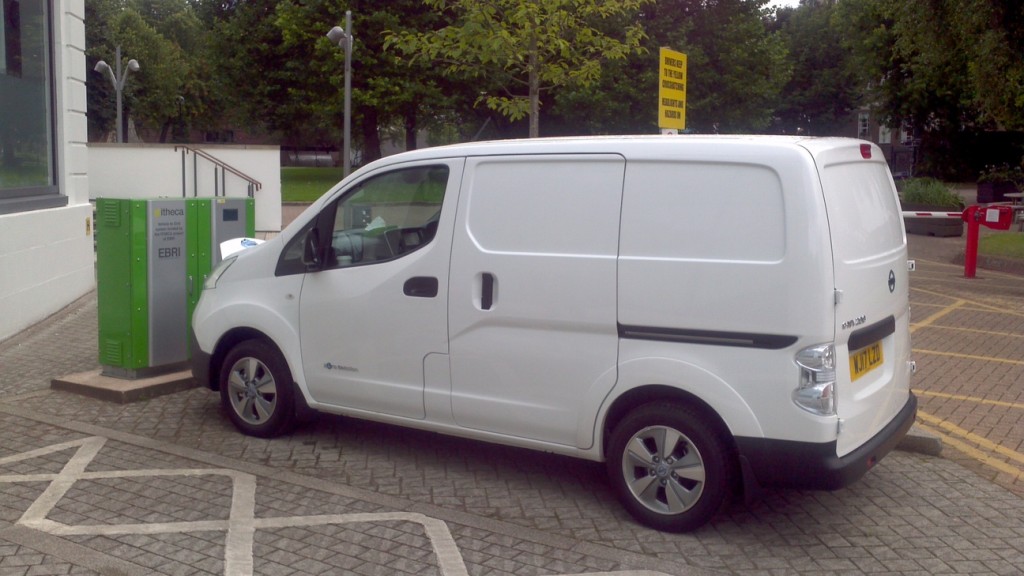
External storage and vehicle-to-building is obviously old hat. We’ve personally tested technology that does both those things at the University of Aston:
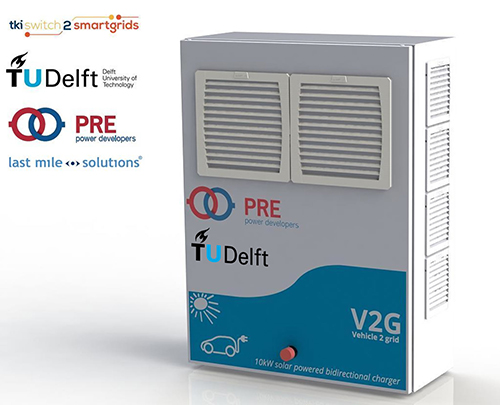
However the EBRI V2G pilot project didn’t incorporate “solar panels” so let’s take a look at another recent press release shall we? This one is from the Technical University of Delft in the Netherlands:
Electric vehicles and solar power systems are fundamentally direct current (DC) in nature, so conversion to AC leads to unnecessary conversion steps and losses. And two separate DC–AC inverters are required, increasing the cost and size of the power electronics.
Why not use a single integrated converter that charges the electric vehicle from the solar power system on DC? That is what Mouli worked on during his PhD research. Based on Mouli’s doctoral research, TU Delft has developed a quick charger together with the Power Research Electronics and Last Mile Solutions companies which can charge cars directly with electricity from solar panels.
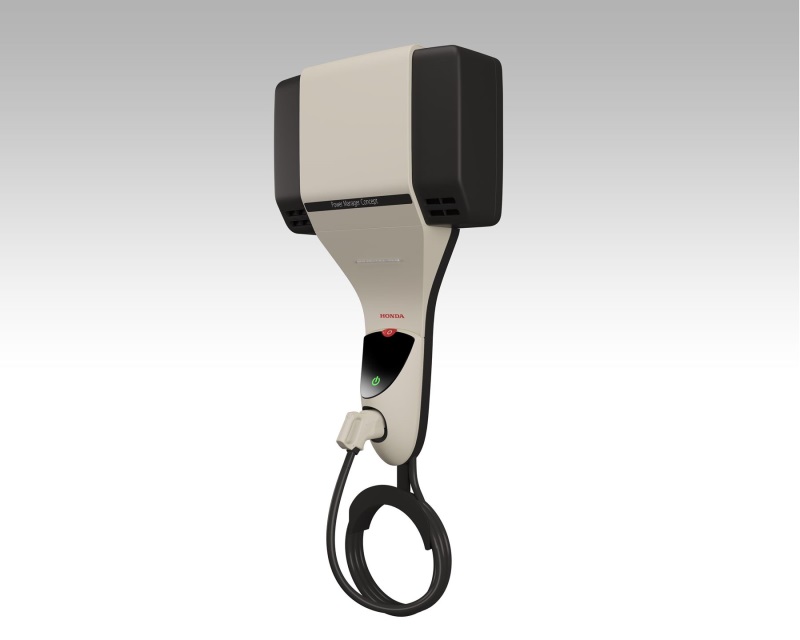
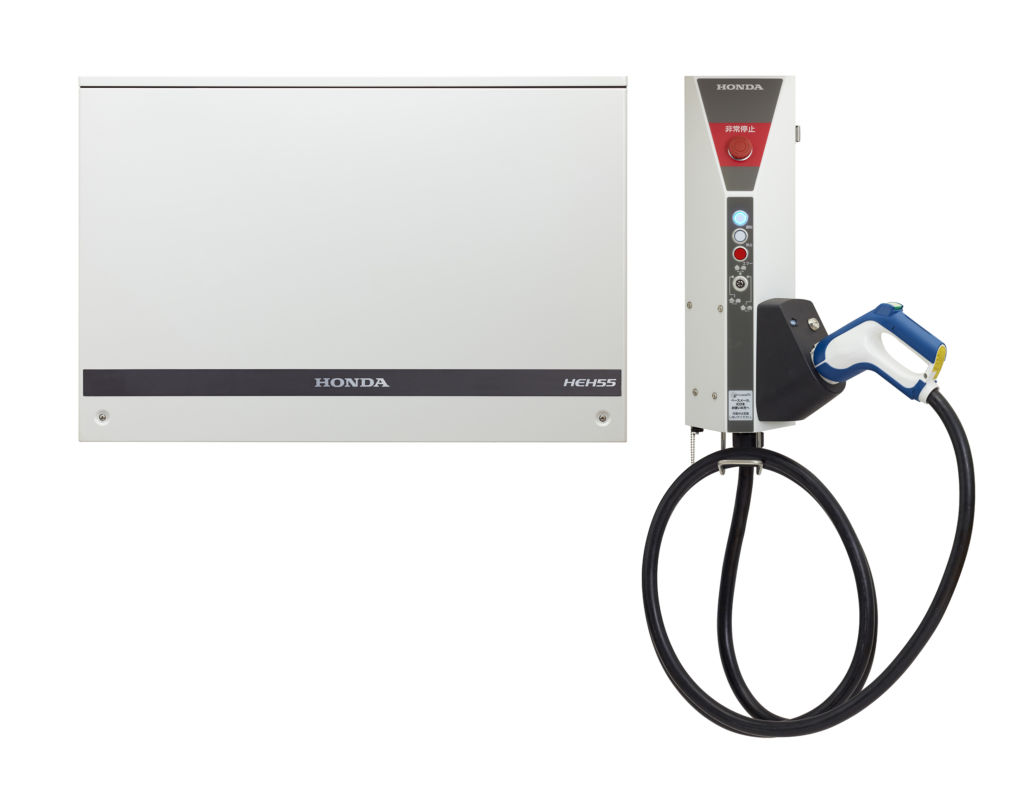
which is presumably based on their current Power Manager technology, which looks like this:
According to Honda:
Power Manager Concept works by aggregating and distributing energy to and from the grid, solar panel-equipped homes or workplaces, and electric vehicles.
Electricity is received into the system from the grid or is generated by the solar panels and can be used to power and heat the building as well as to charge the EV. While the EV is plugged in, the energy can be stored and used at home or sold back to the grid, potentially generating value for EV owners.
Hitachi’s new offering evidently isn’t unique in that regard either then! Here’s their infographic of the ENGIE installation:
That makes it clear as a bell that they’re not doing pukka vehicle-to-grid yet either. Based on that image they also haven’t got any “static” battery storage installed at ENGIE yet.
We reached out to Hitachi and Mitsubishi, and whilst both companies have been very helpful we still don’t have a photograph of the equipment installed at ENGIE to show you. Hitachi point out that “the PV/Battery inverter functionality is the unique aspect of our charger”, but it’s still not clear to us in what way Hitachi’s claim to offer “the first vehicle to everything (V2X) charger” is justified. That being the case we have a suggestion to make. Perhaps Hitachi could let us test one of their new units at our V2G Living Lab just outside Camelford in Cornwall. Then perhaps we could swiftly establish for ourselves the veracity of the claims of Mitsubishi Motors’ marketing department?
[Edit – April 4th]
Hitachi Europe have pointed me at this Dutch language press release from ENGIE which includes an image of their charging station in action: