Nissan UK Announce V2G Enabled Next Generation LEAF

There have recently been a series of press releases from Nissan UK about their forthcoming range of electrically powered vehicles. At the end of May Nissan UK announced the electric MICRA. Yesterday they launched what was described as “The all-new LEAF“:

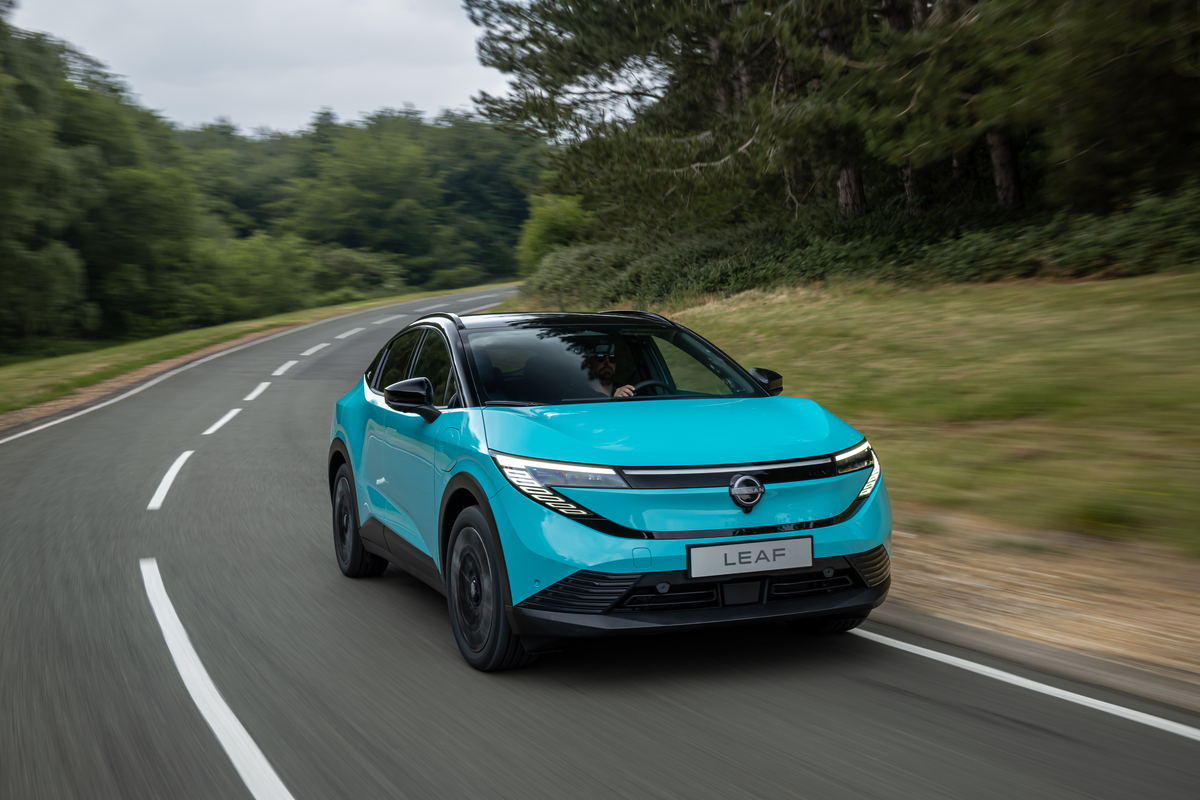
Today marks the debut of the all-new version of the Nissan LEAF – a British-built electric car icon.  

  • The all-new Nissan LEAF is the next step in Nissan’s EV journey, building on its legacy as the world’s first mass-market electric car
  • The sleek, aerodynamic, and spacious crossover design comes with two battery options for an impressive range of up to 375 miles (WLTP), ensuring confident driving for everyday and long-distance trips
  • Delivers a fully connected mobility experience with Google built-in, dual 14.3” screens, and advanced driver assistance technologies
  • Built in Sunderland, UK, as part of Nissan’s EV36Zero initiative, supporting a sustainable electric future for Europe

This third generation of the pioneering LEAF continues to lead the charge in Nissan’s electrification strategy with a sleek design, significantly extended range, and intuitive technology that is seamlessly integrated for today’s connected driver.

Engineered to tackle key barriers to EV adoption, the all-new LEAF has a substantially increased maximum range of up to 375 miles on a single charge for a no-compromise driving experience. It also offers enhanced charging speeds (up to 260 miles of range in 30 minutes) and a suite of technologies that make both driving easier and EV ownership more rewarding.

Since its debut in 2010, the Nissan LEAF has sold close to 700,000 units worldwide, earning its place in history as the world’s first mass-market electric vehicle. Today, Nissan is ushering in a new chapter for this nameplate, re-designed and re-engineered to meet the needs of modern EV customers, while remaining true to its innovative roots…

Designed at Nissan’s Global Design Studio in Atsugi, Japan, the all-new LEAF introduces a stylish silhouette that reflects its dynamic character and aerodynamic efficiency. With a drag coefficient of just 0.25, its sleek design optimises airflow to enhance both performance and range. Flush door handles, a flowing roofline, full under floor cover, and sculpted surfaces create a modern profile, while its signature front and rear lighting delivers a distinct, high-tech identity on the road.
Pretty pictures and low drag coefficients are all very well, but “What about the all new LEAF’s V2x capabilities?” I hear you ask. Heading for the small print I learn that:

Continue reading →

How do you solve a problem like Flexibility?

How do you catch a cloud and pin it down?
How do you find a word that means Flexibility?

We’ll get back to answering that question in due course. First some exciting news.

On November 22nd I attended the kick off meeting of a new International Electrotechnical Commission “smart grid” committee. This one is catchily entitled the “System Committee Smart Energy ad hoc Group 11 on Energy flexibility and residential DSR: common ground”, or “SyC SE ahG 11” for short.

If you follow the link just above you will discover that ahG 11’s mission is:

To consider the implementation of international residential flexibility system standards, their compatibility with national requirements, and propose best practice:

* To ensure the compatibility of end-to-end system solutions at international level,

* To identify emerging challenges related to the uptake of residential DSR,

* To consider terminology alignment, and

* To develop an accelerated report containing requirements for residential flexibility. This would give recommendations for alignment of existing national publications and flexibility projects under development with international standards. It would also identify, if relevant, the need for further standardization

Amongst other questions discussed at the kick off meeting was “How do you define the term ‘flexibility'”. Your mileage may vary of course, but since I spent 5 years of my life meeting 2 or 3 times per week on the committee developing the IEC 63110-1 document I will quote from the Committee Draft for Vote (CDV for short) of that international standard:

General concept of elasticity of resource use, (demand, storage, generation) modification of consumption and/or generation of energy/power, on an individual or aggregated level, in 371 reaction to an external signal (price signal or request) in order to provide a service within the energy system

Elasticity of resource use (demand, storage, generation), modification of consumption and/or generation of energy/power, on an individual or aggregated level, in reaction to an external signal (price signal or request) in order to provide a service within the energy system.

If you have strong objections to that definition please do not hesitate to join ahG 11, or failing that to send your preferred term of words to me so that I can bring it to the committee’s attention.

My other main action item before the next meeting in the New Year is to generate a list of existing standards, regulations etc. relevant to my particular area of expertise, which is bi-directional power transfer during electric vehicle (dis)charging (BPT for short). More commonly referred to as V2x. Since ahG 11’s term of reference includes the word “residential” this suggests an emphasis on vehicle-to-home technology (V2H for short) . However, homes are of course connected to the local electricity distribution grid, and are not forbidden from feeding electrical energy back into the grid as long as all the associated rules and regulations are adhered to.

Please let me or any other member of the committee know of any “standards” within your own area of expertise that may be relevant to “residential demand side response” (using the UK’s non standard nomenclature!), whether they be international, national, “industry de facto” or even the learnings from relevant “pilot projects”.

To give you a more graphic explanation of what we’re after, here is an extract from one of the documents on my own (by now rather long!) list; the first edition of the British Standards Institution‘s Publicly Available Specification 1878 (PAS 1878 for short)

Please feel free to suggest candidates for “standards” for communicating across any of the arrowed lines in the diagram, and alternative diagrams for that matter!

V2G at the 361 Energy Fair in Barnstaple

The 361 Energy Fair is back in Barnstaple on September 29th. The 2024 event starts at 10 AM in the Pannier Market with an introduction by Ian Roome, the newly elected Liberal Democrat MP for North Devon.

To give you a better idea of what to expect, here’s a video with extracts from previous 361 energy fairs:

For the first time this year’s fair includes a series of talks on a variety of topics. Our very own Jim Hunt will be giving a presentation on the topic of “An introduction to V2x, making greater use of EV batteries”, and the emphasis will be on vehicle-to-home and vehicle-to-building rather than fully fledged vehicle-to-grid.

Continue reading →

V2G at Everything Electric NORTH 2024

I was fortunate enough to find myself on stage for two different panel sessions at the Everything Electric NORTH show in Harrogate last weekend. We recorded those two sessions in full for posterity, but there were plenty of other interesting topics apart from V2x. Some extracts from those can also be found below.

My first panel on Saturday was on the topic of “Vehicle to Everything? What’s the true potential?”, held in the EEN “Giga Theatre”. The tagline for the session was “We believe that V2X could be the biggest benefit of all in a world with battery electric vehicles, but how do we go ‘bidirectional’?”:

As you can see from the video below, I found myself sat next to Robert Llewellyn of Fully Charged fame as a last minute replacement for host Dan Caesar:

Mark Potter from 3ti explained the full suite of V2x three letter acronyms (TLAs for short).

  • V2L = vehicle-to-load
  • V2H = vehicle-to-home
  • V2B = vehicle-to-building
  • V2G = vehicle-to-grid
  • V2I = vehicle-to-infrastructure
  • V2V = vehicle-to-vehicle
Continue reading →

Renault Reveal V2x Enabled R5 at Geneva Motor Show

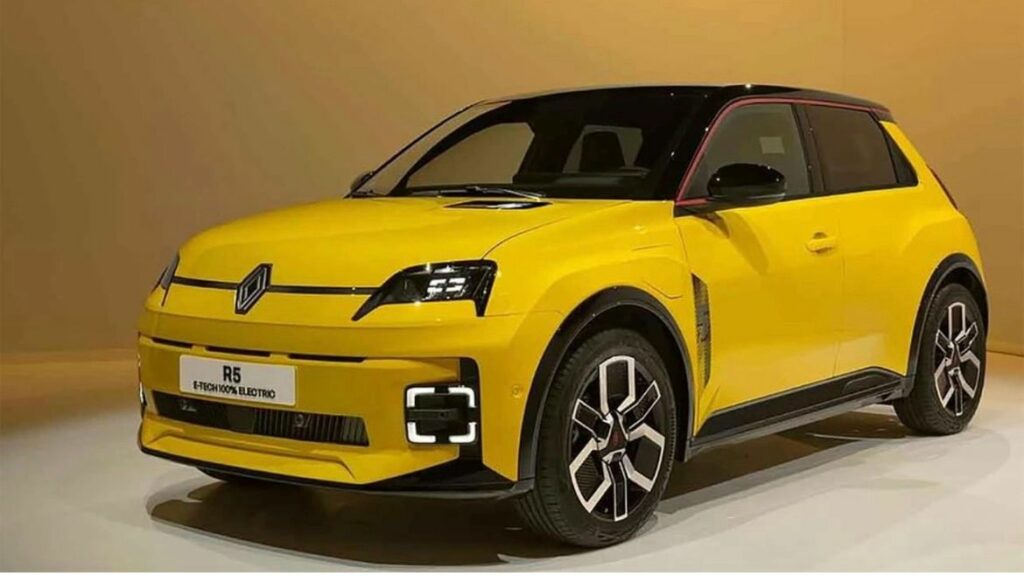
We have been following the progress of the new Renault 5 for quite some time, and the long awaited reveal of the R5 will be live streamed tomorrow from the 2024 Geneva International Motor Show.

Some pictures of a bright yellow version of the “production” Renault 5 have been “leaked” to the press. Here is a sneak preview:

And from the reverse angle:

Continue reading →

Tesla Reveal Powershare V2H on Cybertruck

After maintaining an anti V2x stance for many years Tesla have finally accepted the inevitable! On the new Powershare page on the Tesla web site they say that:

Tesla vehicles* equipped with Powershare technology have onboard electronics that unlock your battery’s ability to provide power whenever you need it, wherever you are. Whether you need to power a construction site, pre-game tailgate, another electric vehicle or even your home during an outage, your Tesla vehicle with Powershare has you covered.

That sounds awfully exciting, but following the asterisk to the small print at the bottom of the page reveals that:

Tesla Powershare is currently available for Cybertruck only.

Without actually mentioning vehicle-to-load or vehicle-to-home Tesla suggest some use cases for the newly unlocked power:

Continue reading →

GM to make V2H technology available across Ultium-based EVs by model year 2026

According to a General Motors press release earlier this week:

GM will expand vehicle-to-home (V2H) bidirectional charging technology across its retail portfolio of Ultium-based electric vehicles by model year 2026. The first vehicles to receive the technology include the previously announced 2024 Chevrolet Silverado EV RST, followed by the 2024 GMC Sierra EV Denali Edition 1, 2024 Chevrolet Blazer EV, 2024 Chevrolet Equinox EV, 2024 Cadillac LYRIQ and the upcoming Cadillac ESCALADE IQ, which will be revealed on Aug. 9.

Building on the company’s plan to deliver a growing suite of energy management products and services through GM Energy, V2H unlocks additional value for EV drivers, who will be able to transfer energy from their vehicles to a properly equipped home when desired. The technology allows consumers to store and transfer energy to help offset electricity needs during peak demand days and mitigate the impact of power outages, making the transition to an all-electric future even more compelling.

According to the subsequent ESCALADE IQ press release:

Continue reading →

Volkswagen Announce V2H Trial For Their ID. Range of EVs

We got very excited here at V2G UK way back in February 2022 when Volkswagen announced in a press release that Markus Arand, head of brand and product communications at VW Commercial Vehicles, had said:

When you have solar panels on your home, for example, this car will be able to have a thing called bi-directional charging. You can give the energy from the ID. Buzz back to your home.

After a long wait VW have finally published a related press release. This one states that:

From now on, many models in the ID. Family now offer bidirectional charging with the “Vehicle to Home” function. With a home power station and the integrated Home Energy Management System (HEMS) from Volkswagen partner HagerEnergy GmbH, customers can cover as much of their household consumption as possible with their photovoltaic system. Both companies have launched a pilot project in Sweden in which an entire housing estate is being supplied with vehicles and the corresponding charging infrastructure.

Another pertinent piece of information is that:

Bidirectional charging is possible in all new models with the 77 kWh battery (net) and from ID. Software 3.5 or higher.

Note that the “small print” outlines a few constraints:

The discharging and bidirectional charging functions are no longer available once the intended operating time or energy quantity has been reached: Max energy quantities: Up to 10,000 kWh Discharging; Max operating hours: Up to 4,000 hours Discharging

Here’s an image from the press release showing an “artist’s impression” of a VW ID.5 discharging electricity generated from a rooftop solar PV installation back into a home as dusk falls:

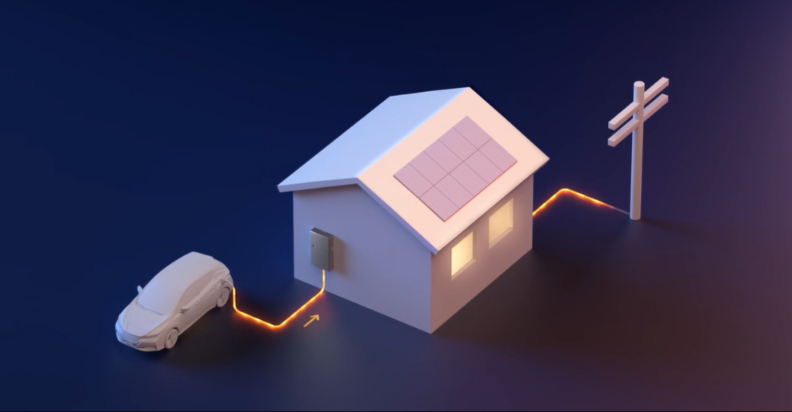
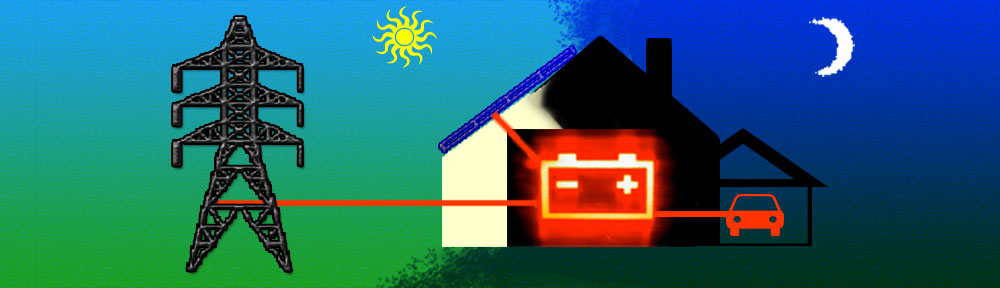
Compare and contrast the image with our own artist’s impression in the banner at the top of this article. It is now over 10 years old.

I cannot help but wonder when the first trial of Volkswagen’s exciting new V2H technology will ultimately start in a similarly equipped home here the United Kingdom, and when the current “constraints” might be raised or removed entirely?

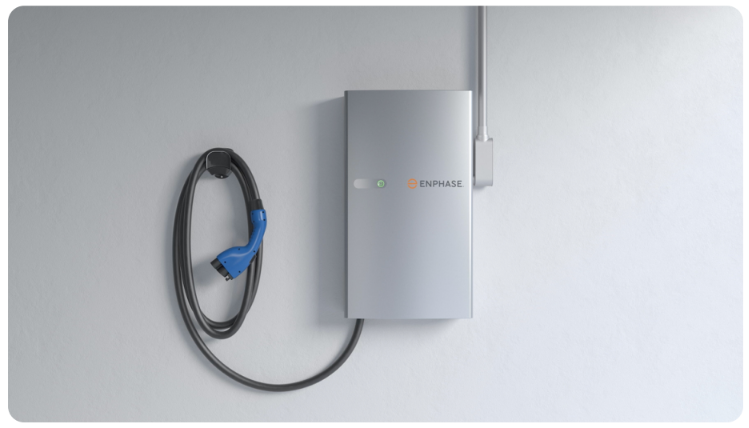
Enphase Announces V2G Charger

It has just been brought to my attention that at the beginning of this month Enphase Energy issued a press release announcing that:

Enphase Energy, Inc., a global energy technology company and the world’s leading supplier of microinverter-based solar and battery systems, announced today a successful demonstration of its bidirectional EV charger enabling vehicle-to-home (V2H) and vehicle-to-grid (V2G) functionality.

This product will leverage the power of grid-forming IQ8™ Microinverters and Ensemble™ energy management technology to seamlessly integrate into Enphase® home energy systems. In addition, Enphase’s bidirectional EV charger is expected to work with most EVs that support standards such as CCS (Combined Charging System) and CHAdeMO (a Japanese charging standard).

Here’s Enphase’s introductory V2G video:

Here too is a still image from the video, which once again looks remarkably reminiscent of the decade old V2G UK banner at the top of this article!

The press release continues:

In addition to charging an EV, Enphase’s bidirectional charger will support the following functionality:

Vehicle-to-home (V2H) –enables the EV battery to provide uninterrupted power to a home during a power outage.
Vehicle-to-grid (V2G) –allows the EV battery to share energy with the grid to help relieve the strain on electric utilities during times of peak energy demand.
Green charging –sends clean solar energy directly to the EV battery.

Raghu Belur, co-founder and chief products officer at Enphase Energy, said that:

The new bidirectional EV charger, along with Enphase’s solar and battery storage system, can be controlled from the Enphase App, empowering homeowners to make, use, save, and sell their own power. We are working with standards organizations, EV manufacturers, and regulators to bring this charger to market in 2024.”

Since I sit on numerous EV (dis)charging and energy management standard development committees it would be very interesting to discover precisely which “standards organizations, EV manufacturers, and regulators” Enphase is working with!

Mohammad Alkuran, Ph.D., senior director of systems engineering at Enphase Energy, added that:

“ The Enphase bidirectional EV charger is the next step on our roadmap to building a solar-powered, all-in-one home energy system that further unlocks electrification, resilience, savings, and control for homeowners. This product will be a game changer for homeowners who want maximum control over their energy usage.”

For those of us that are more technically inclined Enphase Energy has also published a white paper about their bidirectional EV charger. Here’s an extract:

The Enphase Bidirectional EV Charger is part of the Ensemble energy management technology, which is the heart of the Enphase® Energy System™. The Enphase Energy System is a complete solution that produces, stores, monitors, exports, controls, and analyzes the energy in your home.

To achieve this, Enphase Energy System brings solar, batteries, other energy resources like generators, fuel cells, connected appliances and software together in one complete package so that a homeowner can make, use, save, and sell their own power—all through the Enphase mobile app.

Enphase has pioneered power conversion devices called IQ8™ Microinverters. These microinverters are best-in class power electronics components that convert power and comply with standards like UL 1741 for grid reliability functions and IEEE 1547 for interconnection of distributed energy resources (DER). These microinverters can create their own grid, also known as microgrid. They can operate in on-grid mode (as grid-tied) and off-grid mode (creating a microgrid). Enphase microinverter technology is at the forefront of the grid interface for our solar microinverters, storage batteries, and EV chargers.

The Enphase Bidirectional EV Charger leverages Enphase’s IQ Microinverter technology and IQ™ Battery architecture. When the charger is used with a vehicle that supports bidirectional charging, it enables the transfer of power and communication between the Enphase Energy System and the EV. The combination of the EV and the bidirectional charger is similar to an Enphase IQ Battery and can be controlled in an equivalent fashion.

The use of the terms “grid-forming” and “microgrid” is of particular interest to yours truly, since not all V2x charging stations are so well endowed.

Roll on 2024!

General Motors Announces “Energy Ecosystem”

Back in March General Motors announced a vehicle-to-home pilot project in partnership with Pacific Gas and Electric. According to Mary Barra:

Bi-directional charging will help when there’s a power outage or additional demand, to really help supply energy and keep everybody having the energy they need to live their lives.

Now the next phase of General Motors’ master plan to beat Tesla at the energy game has been announced, in a press release yesterday:

The introduction of Ultium Home and Ultium Commercial, which in combination with the existing Ultium Charge 360, create a holistic ecosystem of energy management products and services that will be housed under a new business unit called GM Energy.

GM Energy’s connected product and service offerings are designed to offer cohesive energy management for home, commercial and EV customers, with solutions ranging from bi-directional charging, vehicle-to-home (V2H) and vehicle-to-grid (V2G) applications, to stationary storage, solar products, software applications, cloud management tools, microgrid solutions, hydrogen fuel cells and more. GM Energy’s services will also enable the sale of energy from EV and stationary storage batteries back to utilities during peak, high energy consumption periods, unlocking even more potential value for customers and increasing resiliency for the electrical grid.

Several large-scale companies across the U.S. have already agreed to work with GM Energy to provide energy solutions to customers and receive product or service offerings.

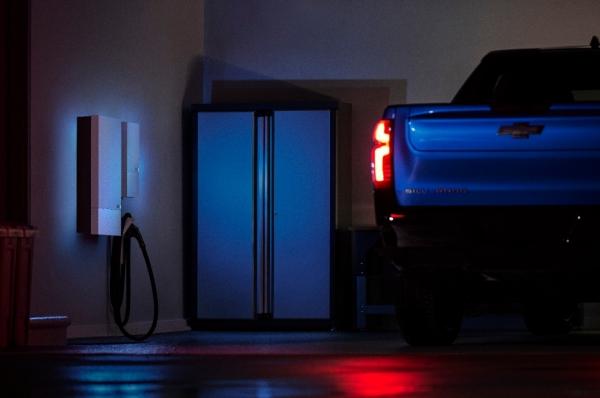
Among them is an agreement with SunPower, one of the nation’s leading solar technology and energy services providers. Together, the two companies will develop and offer customers a home energy system which will consist of integrated EV and battery solutions, solar panels and home energy storage. A primary feature of the home energy system is expected to enable drivers to deliver power to their homes with the battery in their compatible electric vehicle, designed to give them the ability to power their home’s necessities in a blackout or draw from stored energy during peak rate times. SunPower will also become a preferred installer for the home energy system and offer customers the opportunity to add solar to their home. The home energy system will be available alongside the retail launch of the 2024 Chevrolet Silverado EV, expected to begin production in fall 2023.

Tesla have of course yet to announce any plans for “the sale of energy from EV batteries”, but Tesla Energy predates GM Energy by several years. Will General Motors be able to catch up and overtake Tesla? Perhaps V2x technology will give GM an edge? Alternatively perhaps Tesla will also be offering V2x on their EVs by the time the 2024 Chevrolet Silverado EV starts production?

Watch this space!